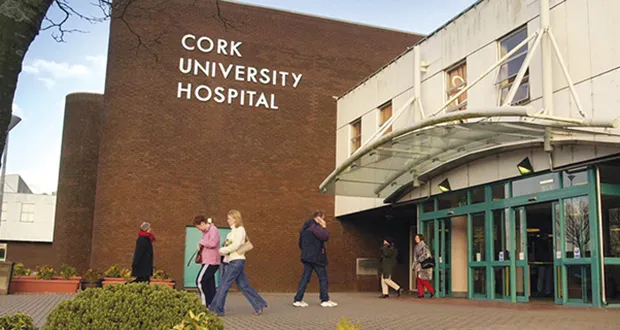
New beds opened to patients at Cork University Hospital (CUH) are being run as an ‘overdraft’, with no additional staff hired to operate them, a leading consultant has said.
Prof Conor Deasy said that nine additional beds at the Awbeg Suite, an outpatient space converted to provide surge capacity, were opened earlier this year without any extra staff recruited to look after patients there. Six new beds have also recently opened on the second floor of the hospital without any additional recruitments.
“They weren’t opened with a headcount, so we are running them as an overdraft, if you like,” the clinical director for emergency and acute care at CUH told IMT.
An additional 21 new beds are set to open towards the end of the year in a part of the hospital previously used for storing medical records. According to Prof Deasy, no plans are in place to hire additional staff for these beds either.
Two new trauma bays which were completed two months ago, but the consultant said the hospital doesn’t have the senior nursing staff in place to open them, while a CT scanner remains unused due to a lack of radiographers.
In a statement, HSE South West acknowledged the radiology personnel deficits, but said that a different approach will need to be taken to staffing new beds.
The statement said: “As we prepare for the Winter period, all effort to maximise available capacity will be essential. The hospital, in partnership with the wider region, will need to consider all available options, including staff redeployment and use of the newly-created Staff Bank to ensure staffing is prioritised to support and utilise available capacity.”
During the summer CUH CEO Jennifer Kearney wrote to HSE South West, warning that a staffing deficit of more than 1,000 could impact patient safety, particularly coming into the busy winter period.
Prof Deasy said these shortages include 347.7 whole-time equivalent (WTE) vacancies that are fully funded. A further 202.37 posts allocated under the HSE Pay and Numbers strategy have yet to be filled, while the number of regionally-approved unfunded positions is 249.
The hospital is also facing staffing gaps due to 166 unfilled maternity leave absences, and 88 people on long-term sick leave. In response, HSE South West said the hospital was already operating with 260 WTE posts above the staffing ceiling set by national health service management.
Figures also released to IMT by the region state that the hospital has just 108 unfilled posts – but these only include vacancies that have been approved for recruitment by senior HSE leadership.
“HSE South West does not hold records identifying any vacant posts that are available for recruitment beyond the approved staffing complement,” a spokesperson for the region added.
Prof Deasy said that senior HSE officials are basing staff figures on individual headcount, and not taking into account that not all CUH staff are full-time.
“For example, I’m half (time) university, half CUH – and they’re counting me as a full CUH (employee),” he said.
“When they’re counting maternity leaves, they’re counting them as two people – even though one is in and one is out. They’re counting the person that’s out on sick leave and the person that’s backfilling for them – when we’re lucky enough to have backfill for them.”
He also referred to many consultants who would have special working arrangements spread across the region, as well as they’re commitments to CUH. Despite this, they are being counted as full-time CUH employees, Prof Deasy argued.
“These problems are probably unique to CUH because other hospitals don’t have the same cross-city cover arrangement that CUH does, or other hospitals don’t have the same cross-region arrangements.”
Under new spending restrictions, all spending on non-clinical items over €10,000 has to be approved by the HSE CEO, while the same levels of expenditure on clinical goods or services has to receive sign-off by the head of the relevant HSE region.
Of these new rules, Prof Deasy said that him and others ‘have been tied up in a very heavily bureaucratic, time-consuming, delaying process, which is undermining our ability to do work we ought otherwise be doing’.
He described the process for seeking approval of new staff appointments as ‘an extremely protracted process if you’re lucky enough for the process to end in the result you’re looking for’.
As a clinical director, he is ‘also involved in the process of mitigating the risk associated with there being nobody in that post. And we’re also handling the staff that have to do more because of there not being people in-post. So, all that impacts’.
Elsewhere in the region, HSE data identified 37.5 unfilled posts in University Hospital Kerry, with 14.5 of those labelled ‘medical and dental’.
In Mallow General Hospital 16 vacancies were noted, while in Bantry just two positions were unstaffed. Cork University Maternity Hospital had 14.8 recorded vacancies.
The region also has two voluntary hospitals, each of which manages their recruitment internally.
In separate FOI correspondence, Mercy University Hospital in Cork said that in August it had a total of 64 permanent staff vacancies, with two medical positions filled on a temporary basis.
South Infirmary Victoria University Hospital had 40 vacancies, with six being advertised and 27 in later stages of recruitment.
Original source: ie