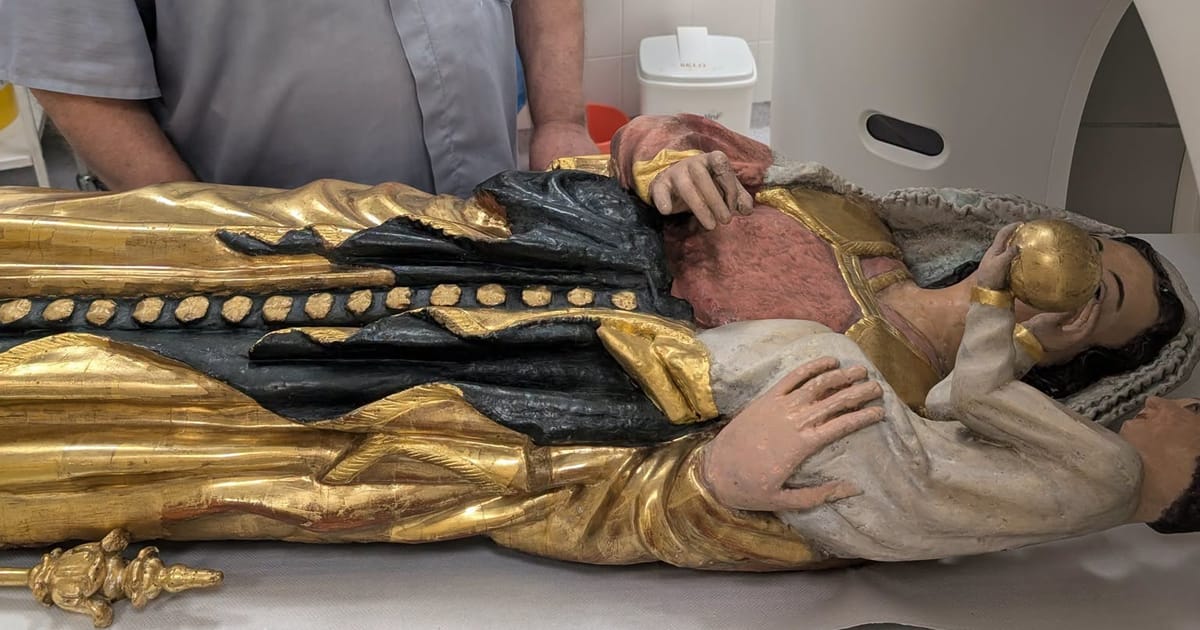
Žarošice is a small village in the south-east of Czechia, close to the borders with Slovakia and Austria. Although it is now home to just over 1,000 residents, the village is a well-known pilgrimage site. Its symbol is the 14th-century statue of the Virgin Mary, which pilgrims can usually see on display in the parish Church of St. Anne, unless, of course, the 140-centimetre-tall wooden sculpture happens to be undergoing a medical examination.
“We performed a CT scan of the statue. Essentially, we scanned it in the same way we scan people, just without contrast dye. From the images, which are taken at intervals of roughly half a millimetre, we can create various reconstructions that doctors normally use to work with living patients and establish diagnoses,” says radiology assistant Radim Sloboda.
The scan itself takes only a few minutes. Afterwards, radiologist Vladimír Červeňák examines the individual layers on a computer.
“We can see the outline of the wood, which appears hypodense. There are many grooves, tunnels and defects, probably caused by woodworm. At the same time, there are metal elements inserted into it. For example, a screw that seems to have been inserted from the outside directly into the wood,” the doctor told Czech Radio.
The statue is carved from linden wood. Based on its internal structure, experts discovered that it is almost entirely made from a single piece of wood, although it also contains other materials. Previous repairs are also clearly visible.
“You can clearly see the tree rings. These curved lines really correspond to the growth rings. The CT scan is an amazing tool because it can also produce 3D reconstructions, allowing us to see every fold in the statue’s clothing.”
The 700-year-old statue of the Virgin Mary is also linked to a legend suggesting that its fate nearly took a tragic turn during the Swedish siege of Brno in 1645. Swedish troops looted the church in Žarošice and, believing the statue to be worthless, threw it into the undergrowth of the Ždánice Forest. There it was found by a devout young man, Josef Němec from Archlebov, and the statue was eventually returned safely to the church.
The statue was brought for the CT examination because it had never undergone this kind of analysis before, and the information known about it had so far come only from historical literature.
“Anything we discover, for example, that the statue is carved from a single piece of wood, gives us evidence for things we previously only assumed. These findings help clarify details that are important to us,” concludes Marián Rudolf Kosík, former parish priest of Žarošice.
The St. Anne’s University Hospital in Brno has previously examined other historic religious artefacts, including a statue of Christ from the Church of St. James in Brno and the Black Madonna.
Original source: cz