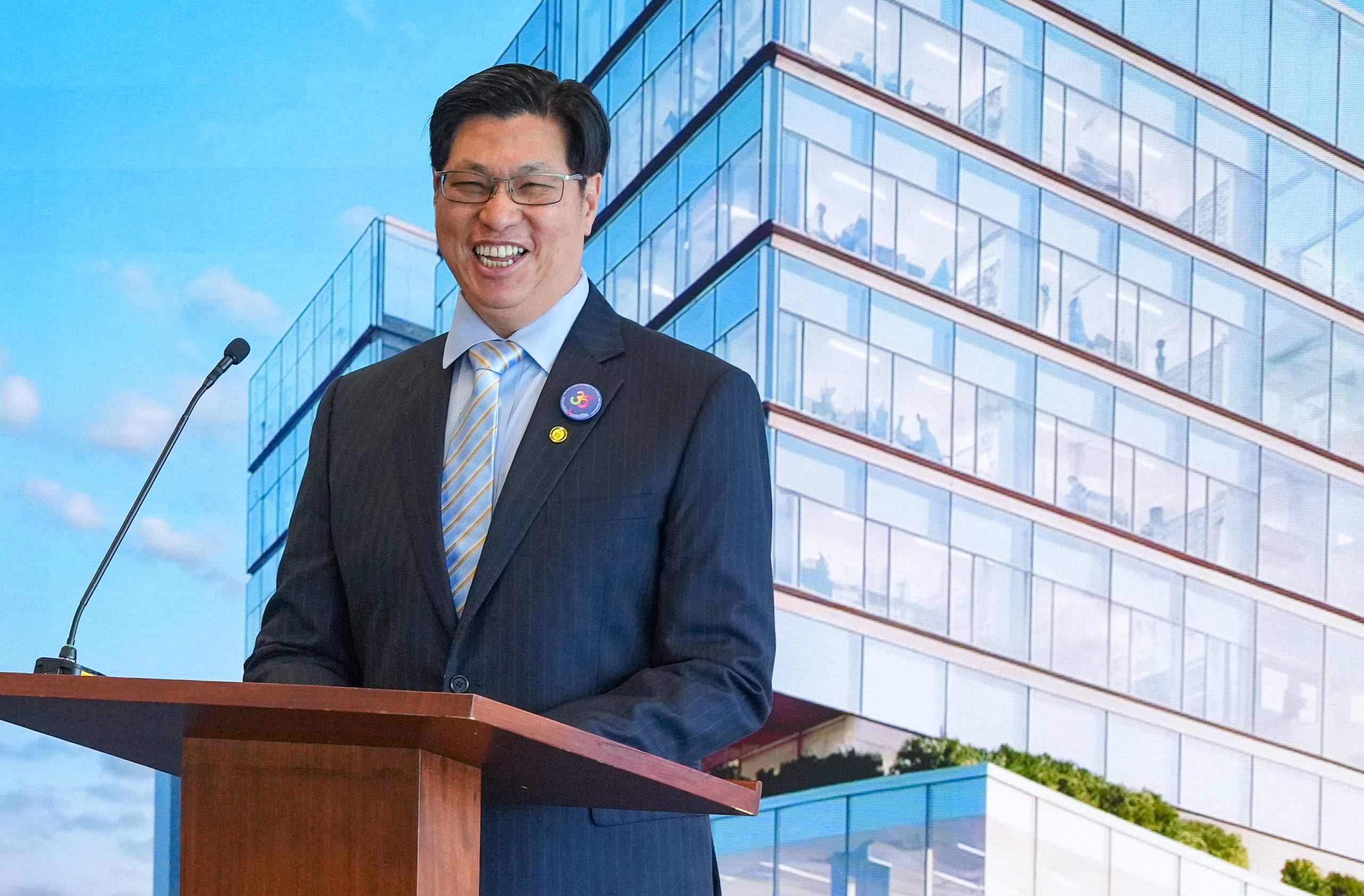
A Hong Kong-born physician-scientist who founded a medical school in the US has returned to the city to lead its third medical school, vowing to nurture future leaders of the “healthcare revolution”.
King Li King-chuen, dean emeritus of Carle Illinois College of Medicine (CI Med), on Monday assumed the role of dean of medicine at the Hong Kong University of Science and Technology (HKUST).
“Using technology and innovation to transform and revolutionise healthcare delivery is [crucial], and it’s something I’ve done before. Looking back on my experience in UIUC [University of Illinois Urbana-Champaign], I see that the opportunity here is actually larger because you have an entire country that has already decided to head in this direction,” he said.
“We want our students to distinguish themselves. Every graduate from this new medical school will function very well in the clinical setting, and this is not the only mission we have for them. We want them to be leading the revolution in healthcare delivery,” he said.
Li was selected from a pool of more than 100 candidates across 10 countries and regions in North America, Asia-Pacific and Europe, Edith Shih, vice-chairperson of HKUST’s council, said.
He holds 20 patents in the United States, Australia and Europe, and has founded a company based on his translational research, according to the institute.
He said the opportunity arose after HKUST president Nancy Ip Yuk-yu approached him.
“President Ip approached me and presented me with something that I cannot refuse – the ability to contribute to a very, very important task that can influence not just locally, but potentially the entire country and the world … without much thinking, I said yes, and here I am.”
Ip said the responsibilities of the founding dean would be “monumental”.
“Serving as our founding dean, he will define our strategic direction and guide our future development,” she said.
“He is an internationally renowned clinical scientist, a biomedical innovator and a visionary educational leader. He is also among the few individuals globally who have successfully built a medical school from the ground up – the world’s first engineering-based medical school.”
Li said Hong Kong, like many developed economies, faced the challenges of an ageing population, placing increasing pressure on the healthcare system.
He said transforming the healthcare system would mean improving quality, lowering costs and increasing accessibility.
“We must have a revolutionary reform to meet this challenge, and that is precisely the goal of the third medical school,” he said.
“We want to train a cohort of doctors who possess not only exceptional medical skills and ethics, but also technological knowledge, innovation leadership, and the ability to seamlessly participate in the innovation and technology economy, contributing not only to Hong Kong and the Greater Bay Area, but also to China and the world.”
He added that achieving this would require collaboration with other disciplines at HKUST, as well as with the city’s two existing medical schools and the wider healthcare system.
“On a personal note, having been away from Hong Kong for many years, I am deeply grateful for the opportunity to return to my birthplace to contribute and give back to society.”
Li was born in Hong Kong and moved to Canada with his family at age 17. He studied physiology and biochemistry, as well as medicine at the University of Toronto, and later earned an MBA from San Jose State University.
He became the inaugural dean and chief academic officer of the Carle Illinois College of Medicine – said to be one of the world’s first engineering-based colleges of medicine under a partnership between UIUC and the Carle system – in 2016.
The college accepted its first class in 2018, which graduated in 2022.
He was described as a “renowned researcher, educator, inventor and clinician in molecular imaging and radiology” by the UIUC provost.
Before that, he was senior associate dean for clinical and translational research at Wake Forest University, a private university in North Carolina, and deputy director of its comprehensive cancer centre.
He also served at the Stanford School of Medicine, the National Institutes of Health Clinical Center and the Methodist Hospital System.
He retired in 2022 after the medical school earned provisional accreditation from the Liaison Committee on Medical Education, which reviews medical-degree programmes.
Li told the press earlier that he would return to San Francisco Bay Area to be close to his children and grandchildren.
According to the university’s website, he is dean emeritus of the medical school and emeritus professor in biomedical and translational sciences and clinical sciences. His key research areas are molecular imaging and image-guided therapy.
The announcement followed the groundbreaking ceremony for the city’s third medical school at the university’s Clear Water Bay campus last month. The new school of medicine is expected to be completed by mid-2028 to welcome its first batch of 50 students.
Hong Kong leader John Lee Ka-chiu has emphasised the school’s strategic role in aligning the city’s development with the country’s development strategy, training high-calibre talent in healthcare innovation, easing manpower shortages and addressing the challenges of an ageing population.
Original source: hk