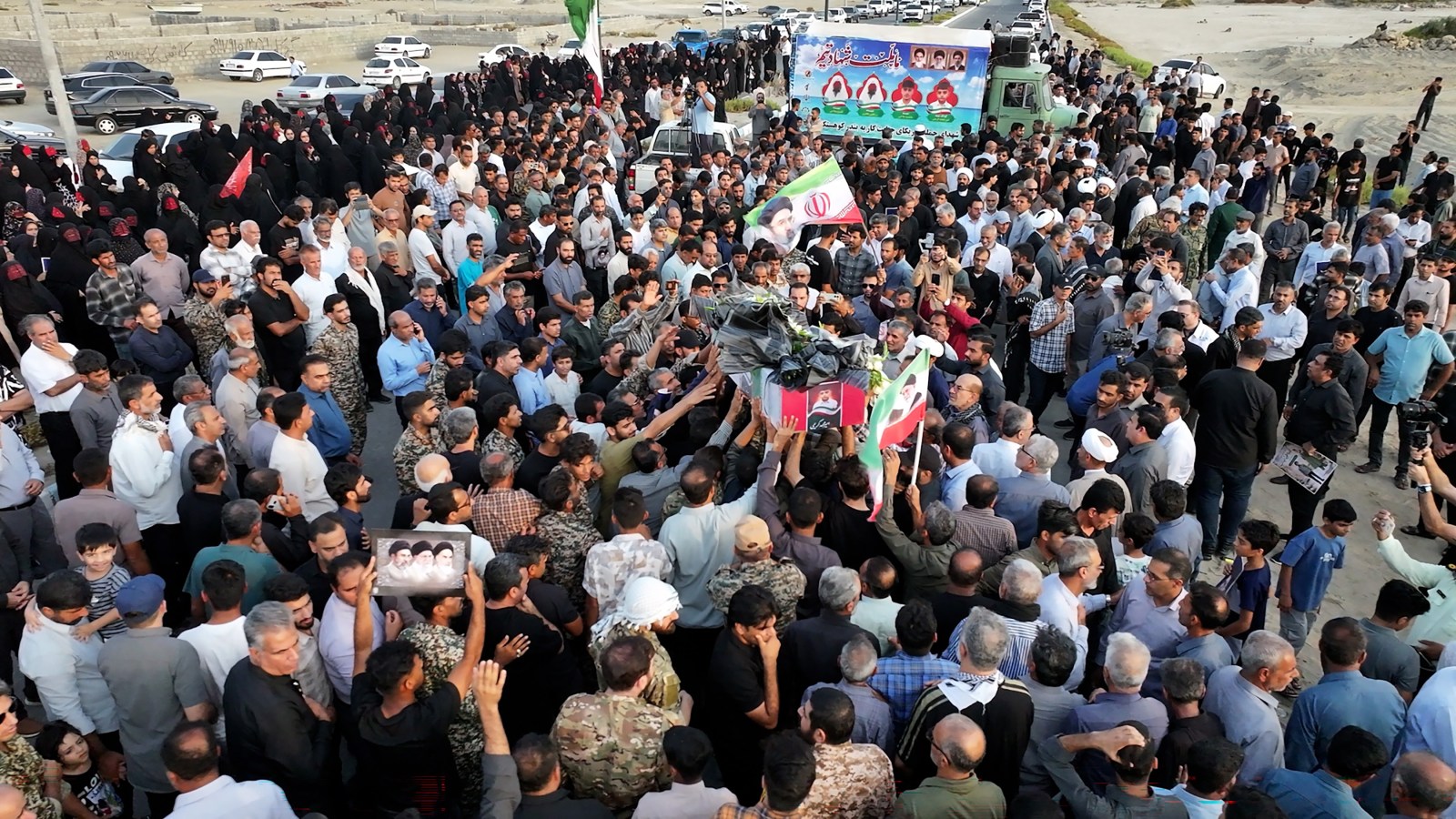
According to Iranian officials, a recent American strike hit a house in Kuhestak where a wedding was underway. More than 60 people were wounded and five were killed. Two of them were children. Somewhere in Iran today, other children are hearing the sound of war above them. Some may be running with their parents to whatever place feels safest, and years from now, long after today’s arguments over military strategy have faded, they may still remember exactly what that sounded like. I know because I was one of those children. My first memories are of a Pinocchio-themed tent and a siren. It was 1984. My brother and I were young boys in Tehran, and Iran had been at war with Iraq for three years, my whole life at that point. We played in that tent, and when the sirens went off our parents carried us down to the basement. I did not know yet that people flew to space, or that rockets could take them there. I knew only that things came out of the sky, and that when they did, the adults were afraid. Later that year, my parents gave up their professions, left everything they had built and brought us to America. Let me be clear about what I am not saying. I am not going to pretend that the choices surrounding Iran are simple, or that I am qualified to resolve them. I am a cardiologist, not a diplomat, and there are people far better qualified than I am to argue about military strategy and foreign policy. But there is something I do know from experience: When governments make decisions about war, the consequences for children cannot be reduced to a casualty count. The effects of a bomb are measured not only by who dies that day, but by what the children who survive carry with them for years afterward. Beyond the physical destruction, war can change a child’s understanding of the world. It makes the sky the enemy. For a small child, there is no geopolitics in it, no military strategy and no final objective. There is only the knowledge that danger comes from above and the adults cannot stop it. That is a consequence we rarely calculate when we talk about military strikes, and it was one I carried out of Iran with me. It took years to undo. When I was six, my parents drove me two hours down I-65 from Nashville to Huntsville, Alabama, to the U.S. Space & Rocket Center. I saw a Saturn V, and for the first time I understood that the things we send into the sky could be something other than instruments of fear and destruction. They could also be instruments of exploration and hope. That single afternoon rearranged my life. I became a doctor and then, 40 years later, on August 29, 2024, I strapped into a rocket in West Texas, flew above the Kármán line (the conventional boundary between Earth’s atmosphere and outer space) and looked down. Here is what I could not see from up there: which country was which. I could not see a single border, the lines that generations die over or the oceans families cross for safety. From that altitude, the whole thing is one unbroken piece of ground beneath a thin blue skin, and every person who has ever lived is there together. I am aware of how that sounds. Every astronaut comes home saying some version of it, and it can land as sentiment. I would ask you to take it as an observation instead. It is simply what is there, and seeing the world that way has left me convinced that those making decisions about war have an obligation to see the people beneath them with the same clarity. The children in Iran today are not the government of Iran. They did not choose its leaders, its policies or its conflicts. Some of them may be in basements right now, and most of them, I hope, will grow up. What they will remember will not be our arguments about their government. They will remember the sound that came out of the sky, being carried to safety and the faces of adults who could not stop what was happening. Military leaders and policymakers will inevitably have to make difficult decisions about threats, security and the use of force. But protecting innocent life, especially the lives of children, cannot be treated as an afterthought to those calculations. Neither can the damage done to the children who survive, because children survive wars in ways that casualty figures never capture. More than 40 years later, I can still remember the siren, the basement and the fear on the adults’ faces. Eventually, I learned to look at the sky differently. A rocket that once represented terror became the vehicle that carried me above the Earth, and the children in Iran today deserve the same chance to grow beyond the fear being created around them now. We are deciding in this moment whether the sky will become a source of fear they spend the rest of their lives trying to escape. Years from now, some of them will still remember what we chose. Eiman Jahangir, MD, MPH, is a professor of medicine and radiology in Nashville, Tennessee, and author of the bestselling book, A Heart for Space: An Astronaut’s Guide to Achieving the Impossible. On August 29, 2024, he became the first Iranian-American man to travel to space, flying aboard Blue Origin’s New Shepard (NS-26). The views expressed in this article are the writer’s own.
Original source: US