A new nanovaccine—a type of vaccine that uses tiny particles for a more targeted delivery to the immune system—could offer a “dual blow” against cancer.
This is the finding of researchers from the National University of Singapore (NUS Medicine) and the Chinese Academy of Sciences (CAS), who have developed the vaccine called NICER to help stop tumor growth and significantly reduce the risk of cancer recurrence and spread after surgery.
NICER works by targeting both bulk cancer cells and the “elusive” but powerful subset of cells called cancer stem cells (CSCs).
The proposed vaccine for postoperative cancer immunotherapy stands for “Nanovesicle Integrating CSC-specific antigen display and epigenetic nano-regulator encapsulation.”
Early laboratory models show hope of its potential for breast cancer, which U.S. women have a one-in-eight lifetime chance of developing, according to the American Cancer Society, melanoma, of which about 104,960 new diagnoses were expected across the country this year, and some highly invasive tumors.
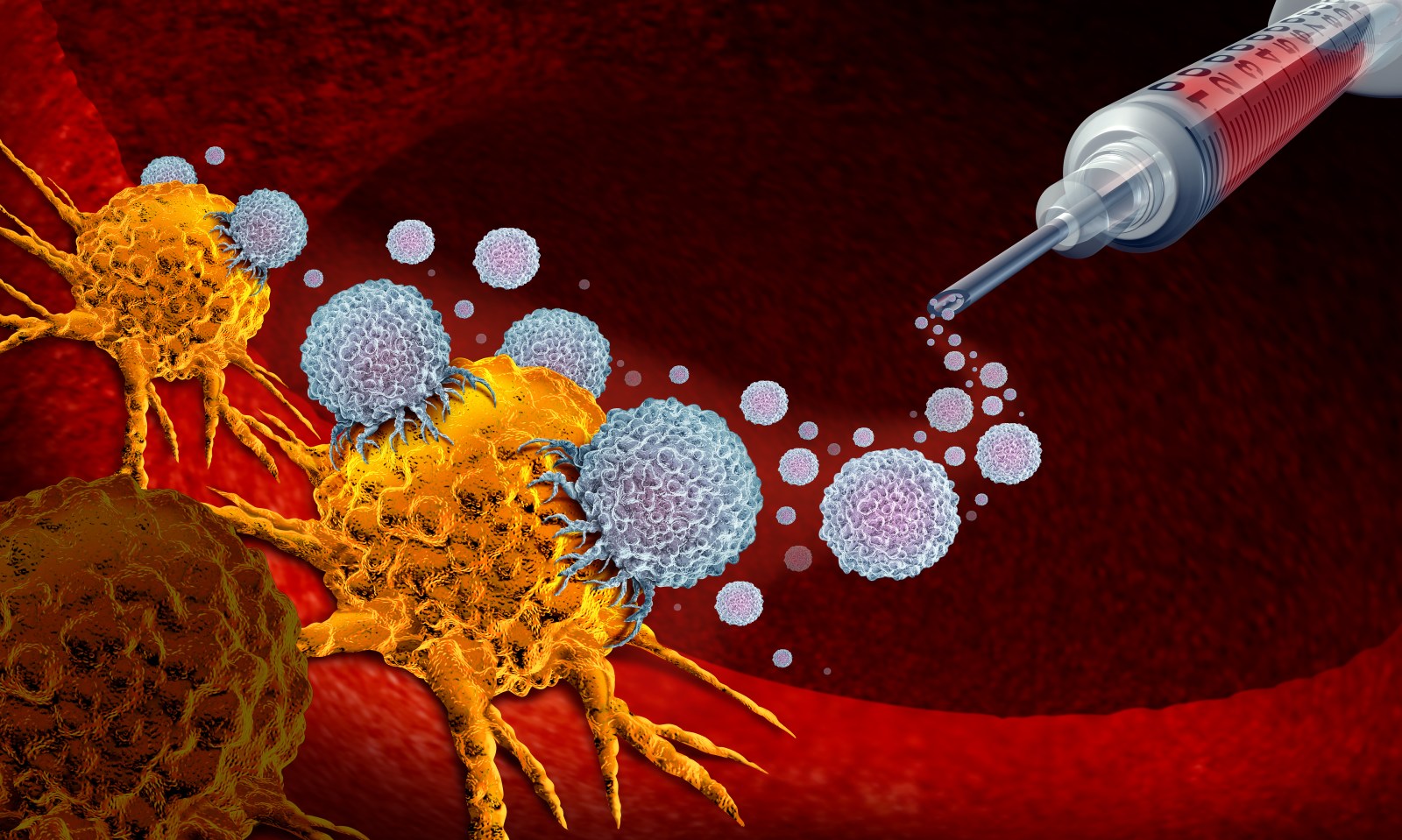
Illustration representing vaccine for cancer treatment using immunotherapy to target cancer cells. | Getty Images/wildpixel
“This nanovaccine approach is especially exciting because it tackles one of the biggest hurdles in cancer therapy—the ability of stem-like tumor cells to cause cancer relapse,” said study author professor Shawn Chen Xiaoyuan from the Department of Diagnostic Radiology and director of the Nanomedicine Translational Research Programme at NUS, in a statement.
“Our results show that our nanovaccine not only activates the immune system to attack these cells but also creates lasting memory to help prevent the cancer from returning.”
Cancer recurrence happens when some cancer cells survive treatment like surgery, chemotherapy or radiation and grow again at the original site or nearby.
CSCs can lie dormant for a period of time, escape detection by the immune system and reignite tumor growth at a later stage.
“Cancer stem cells are a key reason why tumors can return and spread after treatment. They’re resistant to most therapies and hard to eliminate. NICER changes that,” added study author Yanlian Yang of the National Center for Nanoscience and Technology at CAS, in a statement.
NICER offers a potentially stronger and longer-lasting immune response that could help stop the cancer from coming back, according to the researchers.
“In laboratory models which included breast cancer, melanoma and highly invasive CSC-enriched tumors, NICER not only halted tumor growth but also reduced recurrence and lung metastasis following surgical tumor removal,” said study author Dr. Qing You of the Department of Diagnostic Radiology at NUS in a statement.
“When combined with immune checkpoint inhibitors, the vaccine demonstrated synergistic effects, enhancing tumor control and survival outcomes.”
The researchers said while the findings are promising and offer hope of a “new frontier” in personalised cancer vaccines, further studies are needed to assess long-term safety across a variety of laboratory models.
For now, “NICER represents a broad-spectrum vaccine approach against both CSCs and bulk tumors that can significantly inhibit postoperative cancer recurrence and metastasis, prolonging survival rates,” the study authors wrote in the paper.
Newsweek has reached out to the researchers for comment.
Do you have a tip on a health story that Newsweek should be covering? Do you have a question about cancer nanovaccines? Let us know via health@newsweek.com.v
You, Q., Wu, G., Li, H., Liu, J., Cao, F., Ding, L., Liang, F., Zhou, B., Ma, L., Zhu, L., Wang, C., Yang, Y., & Chen, X. (2025). A nanovaccine targeting cancer stem cells and bulk cancer cells for postoperative cancer immunotherapy. Nature Nanotechnology, 20(9), 1298–1311. https://doi.org/10.1038/s41565-025-01952-x
Original source: US