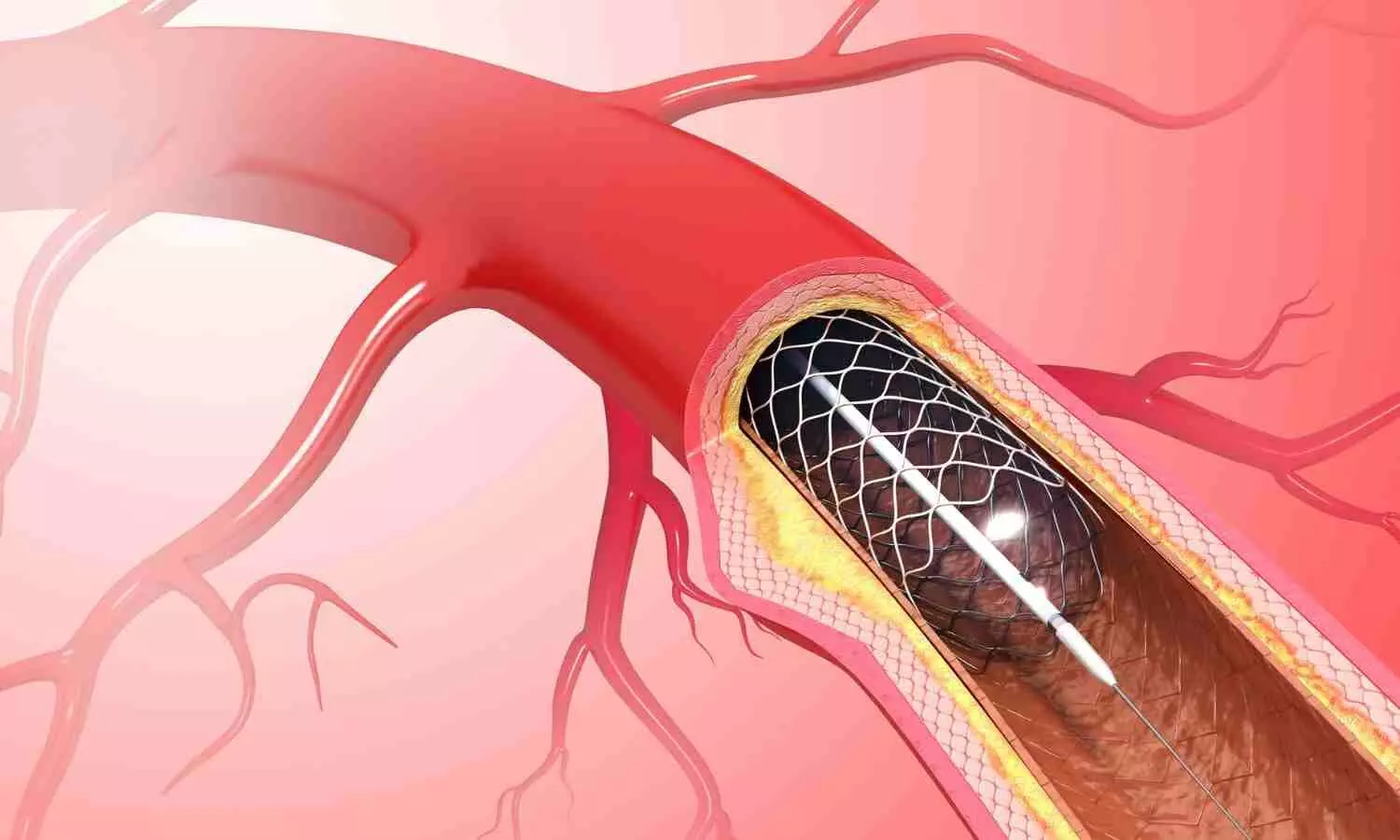
When arterial plaque – a sticky combination of fatty deposits, calcified material, inflammatory cells and other substances – build up on the inner walls of coronary or other arteries, blood flow is restricted, which can lead to heart failure, heart attacks or strokes. Cardiovascular disease is still one of the most common causes of illness and death worldwide. The drug-coated balloon (DCB) has become an internationally recognized treatment option. The procedure involves inserting a thin plastic tube into the affected vessel. The tube has a tiny balloon at its tip, which is then inflated to gently widen the vessel by stretching the vessel wall. What sets this method apart is that the balloon has a drug coating that is delivered deep into the vessel wall during inflation. ‘When a vessel is dilated using a standard balloon, it often narrows again due to excessive tissue growth following the intervention – a process known as “restenosis”. However, if a DCB is used, the drugs in the special coating are transferred into the walls of the artery, where they can remain active for weeks or months, effectively preventing re-narrowing of the vessel,’ explains Professor Bruno Scheller of Saarland University. The DCB technique – now one of the most widely recognized and effective therapies for treating narrowed arteries – was developed by Scheller together with Ulrich Speck, Professor Emeritus of Experimental Radiology at Charité Berlin. Numerous clinical studies have already shown that drug-coated balloons are at least as effective, and in some cases superior, to drug-eluting stents in treating atherosclerosis in smaller vessels (up to 2.75 mm in diameter). The method has been used millions of times in clinical practice. In Asia in particular, DCB therapy has already replaced nearly half of all interventions where drug-eluting stents would previously have been used. Studies demonstrating the efficacy of DCBs in treating small coronary vessels have been published by Scheller and colleagues in leading journals such as The Lancet (Lancet. 2018 Sep 8; 392(10150): 849-856; Lancet. 2020 Nov 7; 396(10261): 1504-1510) and the European Heart Journal (Eur Heart J. 2025 May 2; 46(17): 1586-1599). An international expert group, the Academic Research Consortium (ARC), recently published treatment guidelines for DCBs in both the European Heart Journal (Eur Heart J. 2025 Jul 7; 46(26): 2498-2519) and the Journal of the American College of Cardiology, (J Am Coll Cardiol. 2025 Oct 14; 86(15): 1170-1202), with significant contributions in each case from Professor Scheller. Now, a new international study (SELUTION DeNovo; Spaulding C. et al.) involving more than 3,300 patients has demonstrated that DCBs also offer a safe and effective means of treating coronary arteries with diameters larger than 2.75 mm, for which up until now stents have been the conventional treatment of choice. Stents are metal mesh tubes that are inserted into a narrowed or blocked blood vessel to act as a scaffold to keep it open. Until now, DCBs were primarily used in larger arteries by inserting the balloon into existing stents when these became blocked by new deposits. But the SELUTION DeNovo study shows that DCBs also perform well in larger vessels. After one year, the rate of serious events such as sudden cardiac death, heart attack or the need for a repeat intervention was comparable to that observed with modern drug-eluting stents. ‘We know that drug-eluting stents are very safe. However, we also know that because the stent remains in the vessel, there is a risk of complications over the medium to long term,’ says Professor Scheller, who is Professor of Clinical and Experimental Interventional Cardiology at Saarland University and head of the Cardiac Catheterization Lab at Saarland University Medical Center in Homburg. ‘The advantage of drug-coated balloons is that they deliver medication locally without leaving a permanent implant behind in the vessel.’ The new study also qualifies the findings of the 2024 Chinese ‘Rec-Cagefree I’ study, which had suggested that stents were more effective than drug-coated balloons in treating larger vessels with uncomplicated stenoses (non-complex narrowing) over a two-year period, concluding that drug-coated balloons did not provide lasting efficacy in such cases. At the TCT conference in San Francisco, both the SELUTION DeNovo results and updated three-year data from Rec-Cagefree I study were presented. Professor Scheller discussed these findings with other leading global experts during one of the TCT main sessions. ‘The results of the Rec-Cagefree I study cannot be applied to our method,’ says Scheller. After the original patent for DCBs expired, the Chinese researchers tested a coating that they developed themselves based on the original Charité patent by Professors Scheller and Speck. ‘Their coating differs significantly from ours, not least in terms of drug composition and particle size. The active ingredients…
Original source: in