
Vietnamese-American Hong Pham and his wife Kim are passionate about good food – so much so that once they like eating something, they learn everything they can about how to make it.
They have tried their hand at Vietnamese food like banh cuon (steamed rice rolls) and doi huyet (blood sausage) and have even made a durian ice cream semifreddo pie.
Their latest obsession is Chinese barbecued meats such as char siu and pork belly. Their take on roast duck has got the most attention, resulting in Pham starting an Instagram account called @thatpekingduckguy.
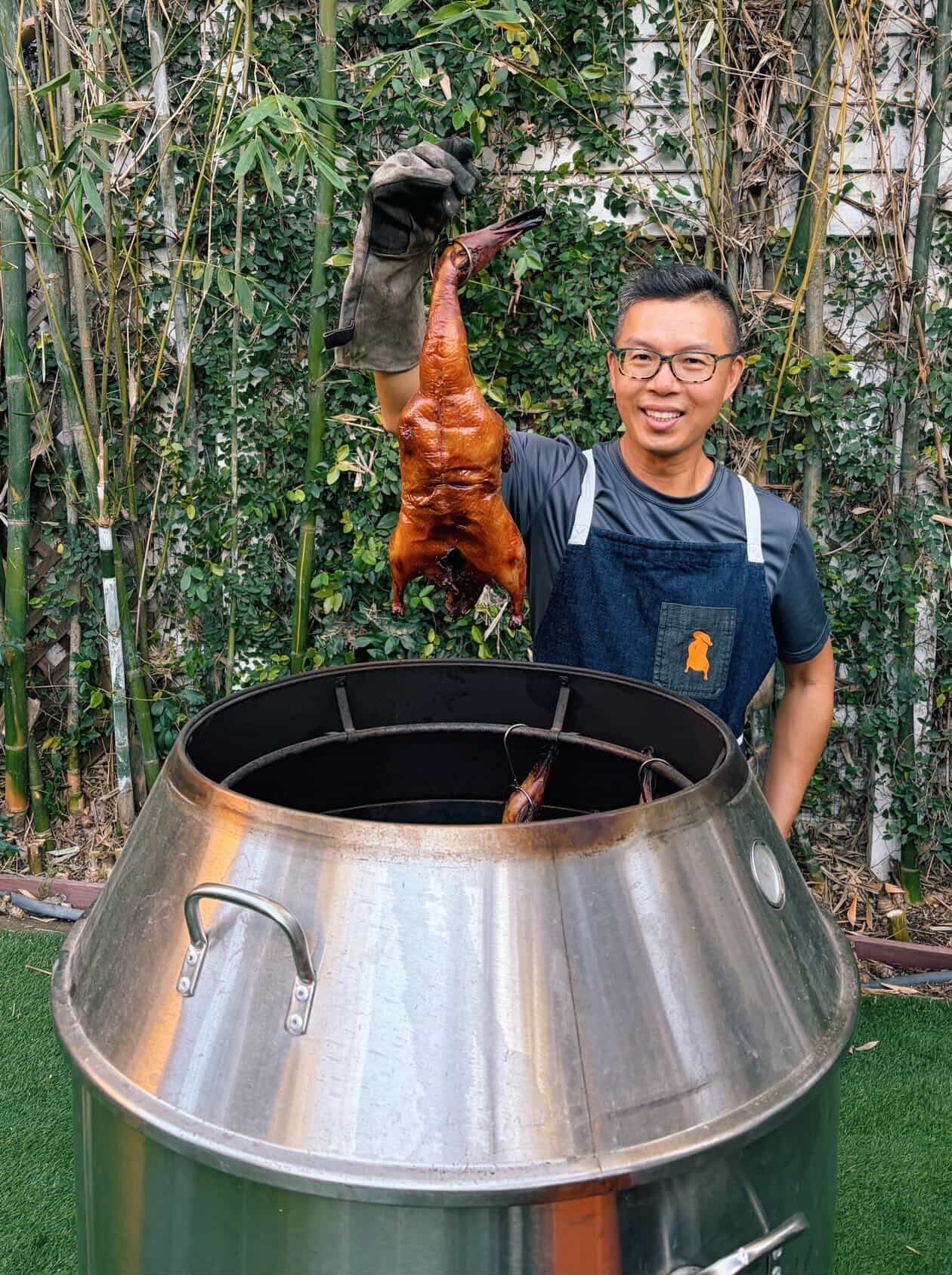
Content includes Pham pulling out glistening maroon-coloured roast ducks from a steel cylindrical charcoal-fired roaster and carving them up to be served in various ways, from traditional Peking duck style – enclosed in steamed thin wrappers with spring onions and sweet bean sauce – to tacos and ramen.
Pham started making the roast ducks in a conventional oven at home. While they tasted fine, he felt they could be better.
“I learned a lot on YouTube and I realised that when I was watching all these videos in Asia, they all had this oven, this duck roaster. I was like, I need to get my hands on that, because that seems to be the most common way of cooking,” he says.
Two years ago, after extensive research on the internet, he ordered a charcoal-fired duck roaster from Alibaba for US$1,000. When the oven was set up in his back garden in Los Angeles, he first used it to make roast chicken and pork belly. It was almost a year before he finally worked up the courage to make roast duck because he found it intimidating.
“It’s because there’s so much fat, and you have to make sure you render the fat properly. When you look at recipes, there are always people talking about separating the skin and then inflating it and glazing it. So there are lots of steps, unlike chicken and pork, which are much easier,” he says.
Pham even reached out on Instagram to reality cooking competition Top Chef’s season 12 winner Mei Lin for advice on how to roast the duck in the Chinese roaster. She encouraged him to keep it as traditional as possible, and just go for it.
With her vote of confidence, he started making Cantonese roast duck, then quickly pivoted to Peking duck. Now he cannot get enough of it.
“Every time I cook it, I learn something new, whether it’s my preparation, my marinade, or how I cook the duck. When I’m using this oven, there’s no dial, just two air vents. So I learn how to use the oven properly to optimise it,” he says.
“There are multiple iterations, and [I’m] just perfecting it as it gets better. And I think that’s also the secret to all these Chinese barbecue places. They do a very limited number of items super well, because they do it all the time, and hundreds and hundreds of iterations each time. So that’s what I need to do in order for me to get better.”
He prepares the Peking duck by pouring hot water over the skin and then ladling over what is called “crispy water” – a concoction of vinegar, honey, water and maltose – to give it the maroon colour. Then he separates the skin and meat with an air pump.
View this post on Instagram
A post shared by Kristie Hang | LA based host & journalist (@kristiehang)
Next, he seasons the cavity of the duck with five spice and white pepper, and ages it for seven to 10 days in a dedicated refrigerator before roasting it.
It takes an hour and 30 minutes to roast a Peking duck. He has tried adding wood to the charcoal fire to try to impart some of its smell onto the duck, but did not find it very effective, so instead just sticks to plain charcoal.
Through social media he discovered pipa duck, a technique where the bird is deboned, marinated and then stretched on a metal frame that looks like a pipa (a Chinese lute shaped like a pear). Pham calls them “guitar ducks”. They have even crispier skin and succulent boneless meat, and take just 45 minutes to roast.
“People here in America don’t know about this duck, which is very popular in Vietnam, because it’s really not made very often. And so I’m slowly converting a lot of people to it,” he says.
“It takes a lot more work ahead of time to prepare, because I debone everything. But once it’s done, it’s great because it’s boneless and the skin is very crispy. I think you get the best of both worlds between Peking duck and Cantonese roast duck, the flavourful meat and crispy skin.”
Nothing goes to waste. The carcass is used to make stock for soup or ramen, while the meat is sliced to fill tacos, tortillas and even banh xeo (Vietnamese crepes). Pham says his family, including his two children, have not missed eating chicken.
His biggest challenge is finding ways to use the copious amount of duck fat that results from the cooking. So far, he has made duck fat fries, duck fat tortillas, duck confit and confit garlic.
‘Everyone loves the crispy skin’
When Pham fires up his roaster, he does not have a hard time finding people willing to take a roast duck home.
He charges US$110 for a whole meal kit, which includes either one whole Peking duck or one pipa duck along with garnishes, pancake wrappers, duck noodles with duck bone broth, and seasonal vegetables to feed a family of four. He says some people have driven over an hour to pick up the meal pack and reported it was still warm and delicious when they brought it home.
“I make the Peking duck almost exclusively because everyone loves the crispy skin,” he says.
Pham has practised radiology for the past 20 years, but as his roast ducks have become so popular, he is now looking to pivot to building a catering business. He has trained a younger man, Scott Lem, who has his own side project of making charcuterie, on making the ducks and using the roaster.
“I’ve done several catering events already, where I go to someone’s yard and set up the roaster and help them celebrate a special event. Usually it’s a graduation, big anniversary or big birthday,” Pham says.
“I just did one for a Chinese couple’s 50th anniversary, and all their guests were Chinese. I set up the roaster and roasted the duck. I usually have the host, or whoever is celebrating, be the first person to pull out the duck, and it’s always a great show – all their friends take photos and film videos of them pulling it up.
“They always tell me [afterwards] that it was such a fun experience. So when we do those roasting events, it’s really fun. Honestly, it doesn’t even feel like work.”
Original source: cn