
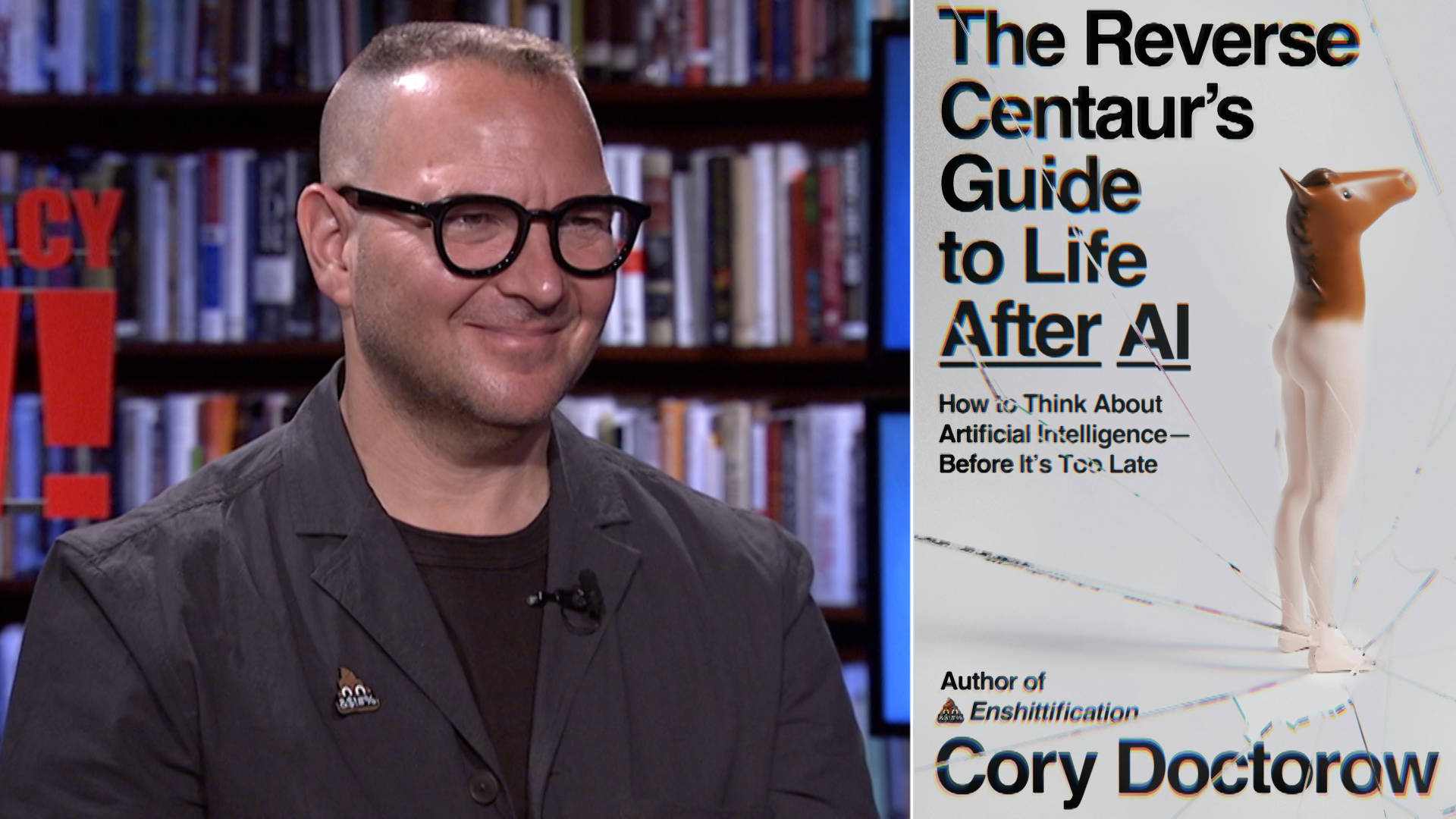
Democracy Now! speaks with science fiction author, activist and journalist Cory Doctorow about AI and his latest book, The Reverse Centaur’s Guide to Life After AI: How to Think About Artificial Intelligence — Before It’s Too Late.
Doctorow comments on AI’s “bad unit economics” and the connection between automation and labor. “When labor drives automation, it’s usually in service to making the product better, and when capital drives automation, it’s usually in service to making more of the product,” says Doctorow.
This is a rush transcript. Copy may not be in its final form.
AMY GOODMAN: This is Democracy Now!, democracynow.org. I’m Amy Goodman, with Nermeen Shaikh.
NERMEEN SHAIKH: Earlier this month, Elon Musk became the world’s first trillionaire when his company SpaceX went public in the biggest IPO in Wall Street history. SpaceX is a space flight, satellite internet, social media and AI conglomerate. The value of SpaceX initially soared, but it’s since fallen as part of a global sell-off in tech stocks. On Wednesday, Bloomberg reported that Musk had lost his status as a trillionaire, at least temporarily. This all comes as fears are growing of a possible AI bubble that could collapse, triggering an economic recession.
AMY GOODMAN: We’re joined now by Cory Doctorow, acclaimed tech activist, journalist, science fiction author, has worked for the Electronic Frontier Foundation for decades. His latest book, The Reverse Centaur’s Guide to Life After AI: How to Think About Artificial Intelligence — Before It’s Too Late. His previous book titled — let’s see, how should I say it on a broadcast? — En[bleep]ification — but that’s not really the title — Why Everything Suddenly Got Worse and What to Do About It.
We want to thank you so much for being with us, Cory. And also, I want to congratulate you. You have talked publicly about your cancer diagnosis, and also put it in the context of AI, what’s good and problematic about it. But congrats on feeling better.
CORY DOCTOROW: Thank you very much. Yes, six days since the radiologist told me that I am cancer-free. So, let’s hope the next time I go in for a scan, they reaffirm that.
AMY GOODMAN: And yet, you have really shared with people your concerns about AI when it comes to radiology. Talk about how medicine is using it.
CORY DOCTOROW: So, you know, in my other life, I’m a science fiction writer. And people sometimes think science fiction is about describing a gadget. And I think what science fiction is really about is exploring who the gadget does things for and who the gadget does things to. And that’s where radiology comes in.
We’ve heard some pretty credible stuff about how AI can be used to spot solid mass tumors that sometimes humans miss. And, you know, if there was a sales call right now at your local hospital, where there was a pitchman for an AI company telling the hospital administrator, “Here’s what we’re going to do. Right now you have 10 radiologists. They cost $3 million a year. They review a hundred X-rays a day each. And I tell you what: I’m going to sell you a chatbot for a million bucks a year. And it’s going to sit in the shadows, and a couple of times a day, it’s going to tap your radiologist on the shoulder and say, ‘Why don’t you take another look at that one? I’d be very happy,’” that would seem like a real advance on medicine. But that’s not how the pitch is going.
Now, radiologists have a lot of market power, so I’m not saying that this is where they’re going to end up, because right now they’re in short supply. But what the AI companies want to sell you is: fire nine-tenths of your radiologists, save $2.7 million a year, split that between the hospital shareholders and Sam Altman, take that remaining radiologist and put them in charge of marking the AI’s homework, put them in charge of clicking OK a hundred times a minute for the radiology reports that are coming out of the chatbot, and then, when it misses something and someone dies, blame that guy, make him what Dan Davies calls the “accountability sink” for the AI. And, you know, right now the way that we’re using this extremely interesting and impressive technology is to replace humans in jobs where we don’t care if those jobs are done well. And it’s pretty awful to be living through.
I wrote this book because I got so sick of people demanding that I talk with them about AI, because it’s just not important enough that we should all be paying attention to it — massive miscalculation, because now I have to go everywhere and talk about AI.
NERMEEN SHAIKH: But if you could comment, the example of radiologists — and radiologists, of course, also play a big role in the early detection or the detection of cancer when it’s already there. Now, there are a number of leading cancer specialists that increasingly view AI as a vital transformative tool in oncology, principally for augmenting — but absolutely not replacing —
CORY DOCTOROW: Sure.
NERMEEN SHAIKH: — medical personnel, scientists, radiologists, doctors, surgeons, etc.
CORY DOCTOROW: Totally. I mean, look, I think we need to understand the material roots of the bubble to get at what’s going on here. The industry spent $1.4 trillion on AI so far. It’s doubled in the last year. When I wrote the book a year ago, it was $700 billion. So it’s another $700 billion in the last year. Their global revenues — right? — all the money all the companies make per year, they claim it’s $60 billion a year. It can’t be more than $50 [billion], because $10 [billion] of that $60 billion is the money that Microsoft gives to OpenAI, and OpenAI gives back to Microsoft. That’s not revenue. Speaking as someone who writes books about — you know, thrillers about accounting fraud, that’s not even accounting fraud. It’s just a really dumb trick. So, they’ve got $50 billion a year. They’re spending $1.4 trillion a year.
What do they think they’re going to do? Right? How are they going to make up the money? It’s not like they’re going to make it up by adding more customers. AI has very bad unit economics, which is how economists describe what happens when a business sells another one of its widgets or adds another customer. You know, the early web lost money, but every web user made more money for the web companies. Every time they used the web, the web got more profitable. Every generation of the web is more profitable. AI, every new AI customer loses more money for the AI businesses. Every new use of AI loses them more money. Every new generation loses it.
So, I think we look at the labor story here, and what we see is what they ultimately want to do is fire high-waged workers and replace them with substandard algorithms, and then make us accept substandard products. And that’s where they’re going to realize the return on this gigantic investment.
AMY GOODMAN: So, talk about your title, The Reverse Centaur’s Guide to Life After AI. What’s the “reverse centaur”?
CORY DOCTOROW: Yeah, this is not the first time we’ve had automation and labor come into conflict. There’s a rich literature studying the way automation and labor work together. One of the things we know is that when labor drives automation, it’s usually in service to making the product better, and when capital drives automation, it’s usually in service to making more of the product, increasing the throughput, because they bought an asset, right? And that asset is depreciating off their books. They want to maximize the use of it before it’s used up. And so, the person who is in charge of using the machine is exhorted to use it as quickly as possible, which is where we get centaurs and reverse centaurs.
A centaur is a person assisted by a machine. So, think of a human head on a horse’s body. The horse is tireless. It can run faster than you. It’s stronger than you. But you are directing it. Right? So, you ride a bicycle, you kind of look like a centaur. But you use a spell-checker, you’re a centaur, too.
A reverse centaur is the reverse. It is when a human is conscripted to do the tasks the machine directs, so an Amazon bus delivery driver, an Amazon warehouse worker. And reverse centaur is a terrible thing to be, because you’re not just being used by the machine, you’re being used up by it. It works faster than you. It can work longer than you. So it is working you to exhaustion at the limit of your capacity, which is why the most advanced automation we have in warehouses in America, in Amazon warehouses, results in three times the injuries relative to other warehouses. That’s not a coincidence. There’s a causal relationship. Because they’re so automated, they also have more injuries, because that automation is being driven by capital, not by labor.
NERMEEN SHAIKH: And do you think — I mean, sorry, just to go back to the radiology example, because that’s relevant to what you’re saying, right? It’s possible, as they say, AI can scan, you know, X-rays, mammograms, etc., like, I don’t know, a hundred or a thousand times faster — anyway, multiples. I shouldn’t say the exact number; I don’t know. And then a radiologist is to review the findings of AI, because AI also has the capacity to spot very subtle — not because it sees, but because it has patterns or sees trends.
CORY DOCTOROW: Yeah.
NERMEEN SHAIKH: Wouldn’t that be an effective use of a reverse centaur model?
CORY DOCTOROW: If the worker is in charge of scanning, of deciding how the scanning is done — right? — the skilled worker who cares about their patients’ outcomes is in charge of it. I am willing to stipulate — not being a radiologist, I’m willing to stipulate that radiologists know more than I do about how to find tumors. And if they say, “This is how we think we should use it,” not that no worker has ever made a mistake in how they automate their labor, but, as a class, I think workers are the best equipped to tell us how they should be using tools. And as I said, I’ve heard from radiologists who say, “Right now we have a lot of market power, and so when we adopt these tools, we get to dictate how it’s being done.”
But the bubble, the investment, does not exist to put workers in the driver’s seat, to augment workers. The reason they spent $1.4 trillion on $50 billion revenue with terrible unit economics is they think that they can fire workers and corral the remainder into accepting substandard working conditions to produce substandard products.
NERMEEN SHAIKH: So, I mean, just to go back, by way of comparison, in the 2000s, there was the massive dot-com bubble, which people also feared. And indeed, as happened, it wiped out — when the bubble burst, it wiped out numerous, the majority of, internet companies. Nevertheless, these massive corporations now became these huge tech companies, from Google to Amazon and Apple. Do you see the possibility of a similar outcome here? In other words, a lot of the AI now, there are tens of thousands of platforms, most of them will disappear, but there will be ones that are effective.
CORY DOCTOROW: Well, I do think that when the bubble bursts, we’re going to have a lot of residue, right? We’re going to have, like, data centers and GPUs at 10 cents on the dollar. We’re going to have lots of technicians who know how to use them. We’re going to have these open-source models that the tech companies have released, but they thought they were just like demos, and it turns out that when you apply lots of research to them to optimize them and improve them, they can do really impressive things.
But there are really important differences between the dot-com bubble and this one. We talked about the unit economics. We can also talk about the fact that if you look back on the business articles of the day, you know, 1999, 2000, it’s full of people saying, “How will CEOs cope with all these workers who are demanding the web in the workplace?” Today, you go and read those same journals, those same business magazines, and they’re full of articles saying, “What are CEOs going to do to convince their workers to use AI? How many workers are they going to have to fire for not using AI enough, before workers admit that they want it?” So, this is just clearly like a very different phenomenon to the one that we had back then.
And, you know, as you say, what emerged from it were these giant tech companies. And I don’t think it’s a coincidence that five or six years later, we started to have these other bubbles, because what happened was those growing tech companies hit a limit to their growth, because they acquired a saturation in their market, 90% market share in the case of Google and search, and when you stop growing, the market treats you like a less valuable company, not for ideological reasons, but because a growing company’s income will go up next year. And so, if you own a piece of it, it’s worth more than a company that stopped growing. And so, if you’re running Google and you’ve hit a 90% market share, or Facebook or any of these other tech monopolies, you have to worry that the market is going to revalue your shares, and that that’s going to wipe out the net worth of the individuals who run the company, because, after all, they’re being paid in shares. It’s also going to wipe out your ability to hire people with shares, because they don’t want stock in your turkey company, you know? And so, you have to have stories about growth.
AMY GOODMAN: So, I want to go to the subtitle, How to Think About Artificial Intelligence — Before It’s Too Late.
CORY DOCTOROW: Yeah.
AMY GOODMAN: You advise legislators on legislation. You have, for example, movements all over the country. Earlier this month, for example, voters in Monterey Park in California approved a ballot measure that permanently bans the construction of data centers, new ones, defeating a proposal to build a massive new artificial intelligence site near a residential neighborhood. Talk about the movements of resistance and what you think needs to be done right now.
CORY DOCTOROW: Yeah, this is so heartening. It’s such a change from, I think, the way that we tried to do politics, or, you know, the progressive movements tried to do politics for so long, which was to vote with our wallets, mistaking shopping for politics. Right? What we see is, actually, when you mobilize movements, especially at the local level, you can really get stuff done. And, you know, I actually got to tip my hat to the right here, because Moms for Liberty proved to us that the dumbest people you know can make gigantic changes in the material conditions of people on the ground by taking control of these unregarded local offices and involving themselves in these sleepy local political questions, like zoning. And so, you know, if those people can do it and make people’s lives so terrible, imagine what we can do when we organize political movements, instead of just standing in the grocery aisle endlessly dithering about which product is the one that will make the most political difference.
NERMEEN SHAIKH: And if you could talk about — you mention in the book the — which is a seminal event, the Hollywood writers’ strike, which you also participated in, in 2023. Why did you see that as so important and, in fact, exemplary?
CORY DOCTOROW: Yeah. Well, so, these are the only people who’ve really beat back AI in the workplace. And importantly, they didn’t do it by demanding more copyright. We’ve had more copyright added every couple of years for 40 years. The media industry is now more valuable than it’s ever been, and the share of income going to us creative workers is lower than it’s ever been, because, you know, when you’re bargaining with five studios and four labels and three media — music companies and two companies that control all the audio — all the apps, and one company that controls the audiobooks and ebooks, it doesn’t matter how many rights you have. You’re going to bargain them away. It’s like giving your bullied kid extra lunch money. You need to intervene organizationally.
And what the writers had was not a different copyright. What they had was the right to sectorally bargain, to bargain with all of the employers in the sector all at once. And that’s a thing that the Hollywood guilds have, because when we passed the Taft-Hartley Act in 1947, they were powerful enough, they got carved out.
So, you know, we creative workers, we’re at this crossroads. We could demand more copyright, like side with our bosses — they’re the ones demanding more copyright — or we could demand sectoral bargaining, a thing every worker in America would support us in. Do we want to support all the workers in America, or do we want to be on the same side as our bosses? I think, you know, even knowing very little about the technicalities of these issues — and I know lots about it, but even if you know very little — you should say, “Broadly, I’m on the side of all the other workers, and my boss probably doesn’t want what’s best for me.”
AMY GOODMAN: In the last 20 seconds, what’s most important to do about AI?
CORY DOCTOROW: Get involved in organizations. Join EFF, EFF.org. Join Tech Workers — or, Tech Solidarity and Tech Workers Coalition. Unionize your workplace. Get involved in local politics. Be part of a movement. Systemic problems have systemic solutions. You can’t shop your way out of a monopoly any more than you can recycle your way out of a wildfire.
AMY GOODMAN: Cory Doctorow, tech journalist, science fiction author, activist, also ambassador for the Electronic Frontier Foundation for decades, his latest book, The Reverse Centaur’s Guide to Life After AI: How to Think About Artificial Intelligence — Before It’s Too Late.
Happy belated birthday to Karen Ranucci! We’re hiring an education program manager. Check out democracynow.org.
And finally, I’ll be in Rhode Island this weekend, in both Providence, for the screening of Steal This Story, Please!, about Democracy Now!, on Friday and Saturday, then Saturday and Sunday in Newport. Check our website at democracynow.org. I’ll be there with the film’s directors, Tia Lessin and Carl Deal. I’m Amy Goodman, with Nermeen Shaikh, for another edition of Democracy Now!
Original source: US